Eight Furlong is a measurement company, and we build and own our instruments. Three models — a 29-point side-view model, a balance model built from a leading trainer's own method, and a 26-point front-and-rear "wheels" model — trained on frames we labelled ourselves, run on every frame of every parade video a sale company publishes, and grounded in a library of 37,000 sale videos joined to racing records. Below is what we measure publicly — and at the bottom, what we don't.
Sale videos in the library
37,861
yearling, Ready2Race & Karaka, 2018–2026
Read with the side model
23,700+
every frame, every horse — the rest in progress
Read with the wheels model
12,345
front and rear passes
Racing records joined
7,365
yearlings followed to the end of their 4yo season
Three models
Built here, labelled here, owned here.
No off-the-shelf pose model reads a thoroughbred at the walk well enough to measure one. So we trained our own — on parade frames labelled by hand, point by point — and we keep training them.
Model one · side
The 29-point side model
Twenty-nine anatomical landmarks — nose to tail root, wither, girth, belly, hip, stifle, every joint of all four legs — tracked on every frame of the parade. It also tells us what the horse is doing in each frame: walking side-on, standing, coming toward the camera or going away.
29 → 46landmarks — hoof, pastern, head and spine points being labelled now
402hand-labelled frames
0.68%of body length, held-out error
every framenot a sampled still
Model two · balance
A trainer's lines, built into the model
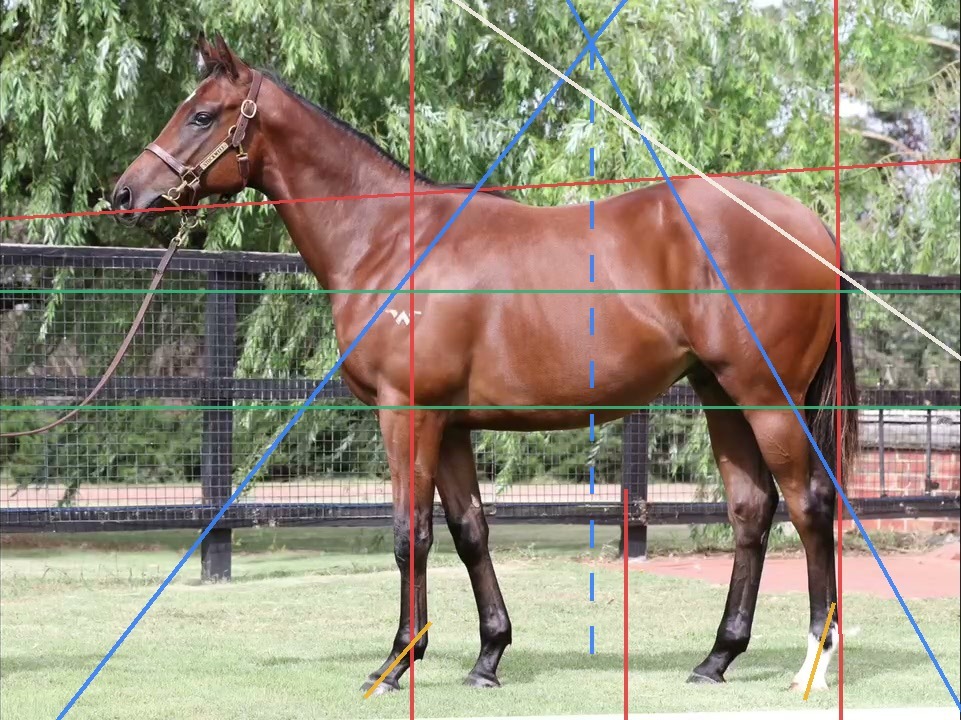
A leading trainer drew his balance method for us — topline, leg plumbs, shoulder and hindquarter axes, chest levels, pastern axes — in his order, with the numbers he looks for. We built every line from the 29 points, anchored on 288 frames he checked, and read it on the stance moments of the walk, where it repeats.
13lines and ratios
288anchor frames checked
60° / 53°hind axis / shoulder — the population lands on his numbers
every horsenot one photograph
Model three · wheels
The 26-point front-and-rear model
The view trainers insist on and no side camera can give: how each foot lands, how the hocks travel, how wide the horse stands, how much the hips swing. A second model finds the end-on passes in the same video and reads 26 landmarks on them — chest, knees, fetlocks, hoof edges, hips, hocks, tail root, nostrils.
26landmarks
327hand-labelled frames
3.2%of hip width, held-out error
12,345videos read
Where we measure
The anatomy of the read.
A real parade — Lot 665 at the 2022 Inglis Melbourne Premier, a $6,000 colt who became a Listed winner rated 99. First the walk as the models see it; then a single frame with the 29 landmarks. Hover any point to see what it feeds.
Every frame, tracked. Persian Spirit's two passes on the 2022 Premier parade — the 29-point skeleton is the model's own output on each frame, smoothed only for display.7.6 s · 230 frames · 30 fps
REAL PARADE FRAME · Inglis Melbourne Premier 2022 · Lot 665 · Persian Spirit · frame 599 of 2,468 · 29 landmarks, side model
Balance. The same horse, stood up, with the trainer's lines drawn by the model: red topline and leg plumbs with C between them, blue shoulder slope and hind axis meeting at the apex, green chest levels, yellow pastern axes, white croup-to-quarter.
Wheels. The same horse coming toward the camera, with the 26-point model's landmarks — hover a point. The away pass reads the hips, hocks, tail root and hind feet the same way.
What we read
Six things, measured on every horse.
Each is measured the same way on every video, ranked against thousands of yearlings read the same way, and checked on horses filmed twice on different days — a measure that does not repeat is shown, never ranked.
Type · the headline read
What kind of racehorse is walking past.
From the frame and the walk, the model reads the trip a horse is built for — sprinter, miler, stayer — and sets that read beside two independent witnesses from the page: the sire's progeny and the dam's own racing. When the three agree, the horse's trip is as good as known.
Yearlings our three witnesses agreed were sprinters went on to race at a median 1,110 m with 3% of their starts at a mile or more; those they agreed were stayers, 1,400 m and 38% — read on a sale year the model had never seen. The read is calibrated: predicted trip matches actual trip in every fifth of the cohort.
Frame
The horse the trainer sees in the ring, in numbers.
Height at the wither, back length, girth and belly depth, hip length, leg lengths and cannon lengths, joint angles — each normalised to the horse's own body so a close camera and a far camera read the same, and age-corrected inside the sale.
Leggier, shorter-backed yearlings reach metropolitan company more often — a lean that has held on three separate crops.
Walk
Swing, reach, rhythm — frame by frame.
Fore and hind swing, stride reach, tracking-up, cadence, head and topline motion, and the regularity of all of it across every stride in the clip. Measured on the moving horse, not a still.
A yearling's walk carries forward: the stride style we read at the sale shows up again in the horse's racing stride on the track.
Balance
A master's eye, made repeatable.
The trainer's thirteen lines — topline angle, shoulder slope, hind axis, where the two meet against the centre of the horse, chest depth and forearm over the cannon, pastern axes, croup to quarter — read on every horse rather than drawn on one photograph.
On thousands of yearlings the population stands where he says a horse should: hind axis 60°, shoulder 53°, forearm 1.3 cannons.
Walk symmetry · a vet's read, from the same clip
Head and pelvis, stride by stride.
The vertical motion of the head and the pelvis through every stride, split at each fore-foot landing — the same quantities a veterinary gait system reads at the trot, taken here from the sale-day walk with no equipment. Shown for every horse as a picture of one walk; on uncontrolled sale footage it is a description of that walk, not a ranking.
Persian Spirit, 9.4 seconds and 8 strides: head and pelvis rise and fall the same on the near-fore and off-fore steps — a level walk.
Wheels
Coming at you and going away.
How flat each foot lands, how far apart and how steady the hocks are, stance width front and rear, hip and tail sway through the pass, foot flight, nostril size — the things a trainer walks around the horse to see.
Read from the same one-minute clip the sale company already publishes — no extra filming, no extra handling.
What we don't publish
The instruments are ours. So is the recipe.
Showing what we measure is rigour. Showing how we combine it would be a gift to the next desk. Four things we deliberately keep private:
×
The models themselves
The three trained models, the labelled frames behind them, and the construction that turns 29 points into a trainer's lines.
×
The scoring
How the type read, the frame and the walk are combined, and how each is weighted inside a sale.
×
The reliability tables
Which measures repeat on the same horse filmed twice, and by how much — the table that decides what we will and won't rank on.
×
The validation pairings
The video-to-racing-record joins behind every number, and the held-out years the models are judged on.
We publish what we measure. How we combine it is the IP.
What this is
"We measure what kind of racehorse is walking past, and how it is built — on every horse, at every sale, before the hammer falls."
Facts about the horse, available on sale day. Not a tip.
Talk to us
Bring this data analysis to your next sale.
Briefings for bloodstock managers, syndicators and trainers. Eight Furlong is private and bespoke — we don't publish picks.